SKY WATCH FRIDAY
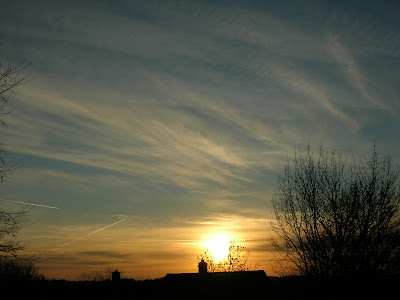
Dot of Strolling through Georgia has come up with a lovely idea..........

 I've just time for a "CHANGES" photo...(view of the garden from the same place once a month)
 Have a great weekend everyone........see you next week!

Dot of Strolling through Georgia has come up with a lovely idea..........
I've just time for a "CHANGES" photo...(view of the garden from the same place once a month)Have a great weekend everyone........see you next week!

August

July

June

February
A collage of overhead views....the top two are the front garden...the bottom two the back garden. The third photo was taken at almost noon....you can see how little morning sun the back garden gets at this time of the year. In fact the lower 2/3rds of the garden towards the house now gets no sun at all. One of the benefits of a warm, dry day yesterday was that I could my homework/studying in the garden!
So much nicer than been cooped up indoors. I've finished it all now so today I'll have time for some pottering......YIPPEE!!! .........as long as the weather holds........................

Gardeners, Plant and Nature lovers can join in every Sunday,
visit As the Garden Grows for more information


 though looking at this photo from last year I see the slugs had their fill of the Hosta!
 My indoor plant Curcuma never came back this year.....these are photos from last year
 My Bourgainvillea last year...............
 This year...................
 and Bill McKenzie started to shoot beautifully in the early Spring and then keeled over and died. How I miss the nodding yellow bells of last year.

Having had some fun days out I've not caught up with last week's newly bloomed flowers....it still surprises me that there's something new to see each week!


Asclepia L., the milkweed,is a herbaceous that contains over 140 known species and is classified as part of the dogbane family. Milkweeds are an important nectar source for bees and other nectar seeking insects, and a larval food source for monarch butterflies and their relatives, as well as a variety of other herbivorous insects specialized to feed on the plants despite their chemical defenses. Milkweed is named for its milky juice and some species are known to be toxic. Strangely enough though Carolus Linnaeus named the genus after Asclepius, the Greek god of healing, because of the many folk-medicinal uses for the milkweed plants.
As I read this information I thought "this reminds me so much of Euphorbia" and sure enough when I looked at the botanical "class"(Magnoliopsida) and "division" they were same....a bit like having the same great grandparents but developing your own characteristics.
I'm not exactly sure which form of Ascepia W.o.t.V had but this is a photo of one that truly proves what a nectar bar it is.
 Speaking of insects....I took a photo of this bee in our garden yesterday afternoon....I'm not sure if it is trying to build a nest, the hole is really small and in the concrete post of the fence....I think it more likely it was sheltering from the weather....................
 and with black skies like this looming I'm not surprised!

 JUNE 2ND

Despite the unseasonal weather everything is still growing and I hear from the weatherman that things may be set to improve!!
A little while ago Gledwood suggested in my comment box that I take some photos from the same angle throughout the year to see how things change; so this morning after I'd taken a few photos I thought I'd have a look through the archives and see if I had any taken from a similar aspect.......I came across one taken at the beginning of February....things have certainly changed a bit in 4 months!


 November 5, 2009